
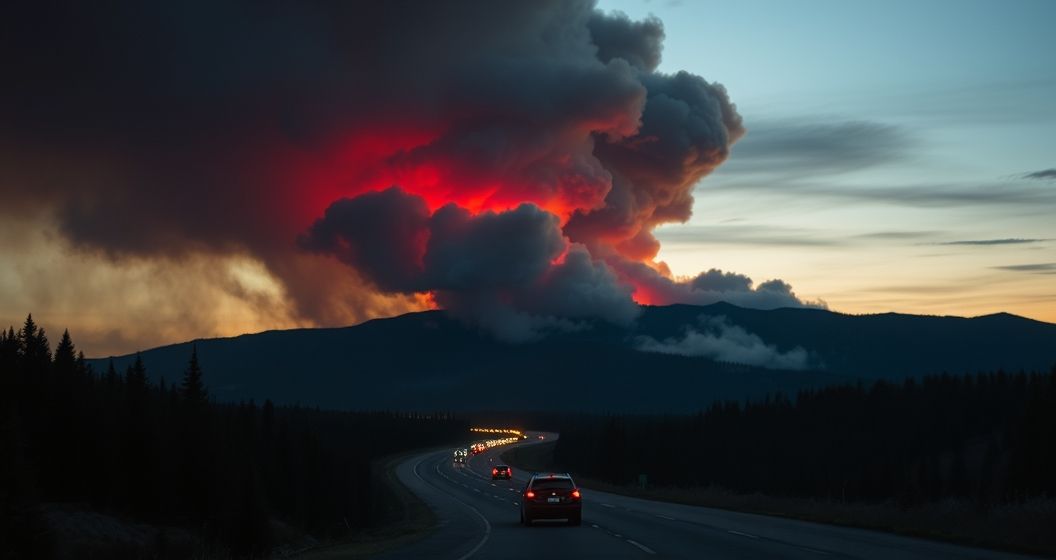
Intensifying wildfires across Western Canada have forced thousands of residents from their homes, with significant blazes threatening communities in both Alberta and British Columbia. Emergency officials are grappling with fast-moving fires fuelled by strong winds and dry conditions, prompting widespread evacuation orders and placing vast regions on high alert. The situation remains volatile as firefighting crews work tirelessly to establish containment lines against the aggressive flames.
Major Evacuations Underway in Fort McMurray
The Regional Municipality of Wood Buffalo has issued an evacuation order for several neighbourhoods in Fort McMurray, Alberta, as the MWF-017 wildfire approaches the city. This order affects thousands of residents in the areas of Beacon Hill, Abasand, Prairie Creek, and Grayling Terrace. The fire, burning out of control, has exhibited extreme behaviour, making it a significant threat to the community. This event brings back difficult memories of the devastating 2016 wildfire that destroyed large parts of the city.
Authorities have urged all affected residents to leave immediately, establishing reception centres in nearby communities like Lac La Biche and Cold Lake. The primary highway south of Fort McMurray has been kept open for evacuation traffic, but officials warn that conditions can change rapidly. The focus remains on ensuring the safe departure of all residents while crews attempt to protect critical infrastructure and residential areas from the encroaching fire.
British Columbia Battles Aggressive Blazes
In northeastern British Columbia, the community of Fort Nelson and the Fort Nelson First Nation remain under an evacuation order due to the Parker Lake wildfire. This aggressive fire has grown substantially, threatening the town and surrounding areas. Fanned by powerful winds, the blaze has challenged firefighting efforts, forcing the majority of the area’s 3,500 residents to seek safety elsewhere. The fire has already damaged some structures on the outskirts of the town.
Challenging Conditions Hamper Firefighting Efforts
Fire crews in both provinces are facing immense challenges. Unseasonably warm temperatures, low humidity, and tinder-dry forests have created perfect conditions for rapid fire spread. Erratic and strong winds are making the direction and speed of the fires unpredictable, posing a serious risk to firefighters on the ground and limiting the effectiveness of air support, such as water bombers and helicopters. These weather patterns are expected to persist, suggesting a prolonged battle ahead.
Widespread Air Quality Advisories Issued
Smoke from the wildfires has blanketed large parts of Western Canada, leading to severe air quality degradation. Environment Canada has issued special air quality statements for regions across Alberta, British Columbia, and stretching into Saskatchewan and Manitoba. Residents, even those far from the fires, are advised to stay indoors, keep windows closed, and use air purifiers if possible. The smoke poses a significant health risk, particularly for children, the elderly, and individuals with respiratory conditions.
As the situation develops, officials continue to provide updates through provincial emergency alert systems. The coordinated response involves hundreds of firefighters, support staff, and aircraft from across the country. The primary goal remains the preservation of life, with residents in affected and nearby areas urged to remain vigilant and be prepared to leave at a moment’s notice.
