
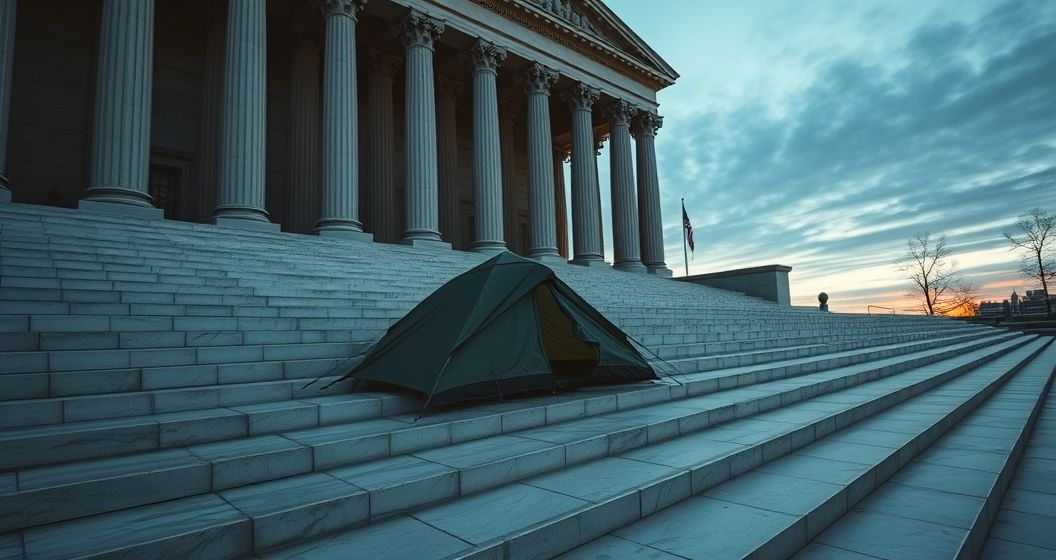
The Supreme Court is currently examining a pivotal case that could reshape how cities across the United States address the growing issue of homelessness. The arguments center on an appeal from Grants Pass, Oregon, a city that implemented ordinances fining and potentially jailing individuals for sleeping in public spaces. This case holds significant implications for the legality of such measures nationwide, forcing a debate on public safety and constitutional rights.
The Heart of the Legal Dispute
The core of the case, known as Grants Pass, Oregon v. Johnson, questions whether punishing people for sleeping outdoors when no adequate shelter is available constitutes “cruel and unusual punishment” under the Eighth Amendment. Lower courts, specifically the 9th U.S. Circuit Court of Appeals, previously ruled in favor of homeless individuals, stating that it is unconstitutional to penalize someone for the unavoidable act of sleeping when they have nowhere else to go. This ruling has set the stage for a major constitutional showdown.
Attorneys representing Grants Pass argue that the city needs the authority to manage its public spaces for health and safety reasons. They contend that the lower court’s decision has left them powerless to address homeless encampments, which they claim pose risks to the community. The city’s lawyers emphasize that their ordinances target the act of camping, not the status of being homeless, a distinction they believe is critical for local governance.
Arguments and a Divided Bench
During oral arguments, the justices appeared divided, reflecting the complex social and legal questions at play. Liberal justices expressed concerns that these ordinances effectively criminalize the state of being homeless. They questioned whether it is just to punish individuals for a basic human necessity like sleeping, especially when local shelters are full or non-existent. Their line of questioning focused on the fundamental rights of individuals who lack private property.
Concerns Over Judicial Overreach
Conversely, conservative justices raised questions about the role of federal courts in dictating local policy on complex issues like homelessness. They seemed sympathetic to the challenges faced by city officials trying to balance compassion with public order. Their inquiries suggested a belief that these policy decisions are better left to elected local leaders and communities rather than being decided by judicial mandate, which they fear could lead to unintended consequences.
Nationwide Implications
The outcome of this case will have a far-reaching impact beyond the small Oregon city. Municipalities across the country, particularly in the western United States where the homelessness crisis is most acute, are closely watching the proceedings. Many cities have similar anti-camping laws that are currently being challenged in court. A ruling in favor of Grants Pass could empower them to enforce these measures more aggressively.
On the other hand, if the Supreme Court upholds the lower court’s decision, it would solidify protections for unhoused individuals and force cities to seek alternative solutions. This could include investing more in affordable housing, shelter capacity, and supportive services rather than relying on punitive measures. The decision, expected later this year, will set a national precedent for how the legal system balances the rights of the unhoused with the authority of local governments.