
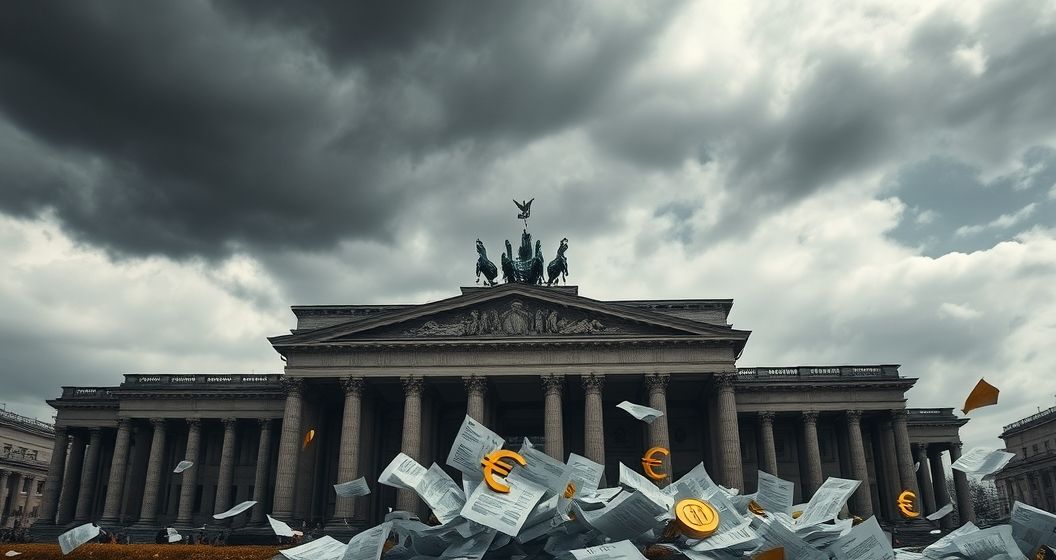
Germany’s coalition government is currently navigating a severe budget crisis, a situation that has exposed deep divisions among its partners and cast a shadow over Chancellor Olaf Scholz’s leadership. The turmoil began after a landmark ruling from the country’s Constitutional Court, which has effectively blown a multi-billion-euro hole in the national finances, forcing an urgent reassessment of government spending and future investment plans.
Understanding the Source of the Crisis
The core of the issue stems from the court’s decision to block the government from reallocating €60 billion of unused debt from the pandemic era into a climate and transformation fund. This fund was essential for financing Germany’s green transition and modernizing its industry. The judges ruled the move unconstitutional, stating that emergency debt could not be repurposed for other long-term projects, thereby invalidating a key component of the coalition’s financial strategy.
This ruling has not only affected the climate fund but has also thrown other special off-budget funds into question, creating widespread uncertainty. The immediate consequence is a significant budget gap for the upcoming year and a freeze on new spending commitments from the affected funds. This has put numerous projects, from energy subsidies to infrastructure investments, on hold indefinitely while the government scrambles for a solution.
Coalition Divided on a Path Forward
The crisis has intensified ideological friction within the “traffic light” coalition, which consists of Scholz’s Social Democrats (SPD), the Greens, and the pro-business Free Democrats (FDP). Finance Minister Christian Lindner, leader of the FDP, is staunchly defending Germany’s constitutional “debt brake,” which limits structural new borrowing. He advocates for significant spending cuts across ministries to close the financial gap.
Conflicting Economic Philosophies
In contrast, the Greens and many within the SPD argue that rigid adherence to the debt brake is counterproductive during a period of economic stagnation and immense transformational challenges. They are pushing to declare another emergency for the upcoming year, which would suspend the debt brake and allow for more borrowing. This fundamental disagreement on fiscal policy is the central obstacle to finding a swift and unified resolution.
Implications for Germany’s Economy and Climate Goals
The budget freeze poses a serious risk to Germany’s economic stability and its ambitious climate targets. Companies that were counting on government subsidies for green technology and energy efficiency are now facing an uncertain future. The lack of funding threatens to slow down the country’s transition away from fossil fuels and could undermine its competitiveness in key future industries, causing concern among business leaders and environmental groups alike.
As Chancellor Scholz works to mediate a compromise, the pressure continues to mount from both the political opposition and the public. The outcome of these negotiations will not only determine the country’s fiscal course but will also serve as a critical test for the stability and effectiveness of the entire coalition government. A solution is needed quickly to restore confidence and provide clarity for citizens and the economy.


