
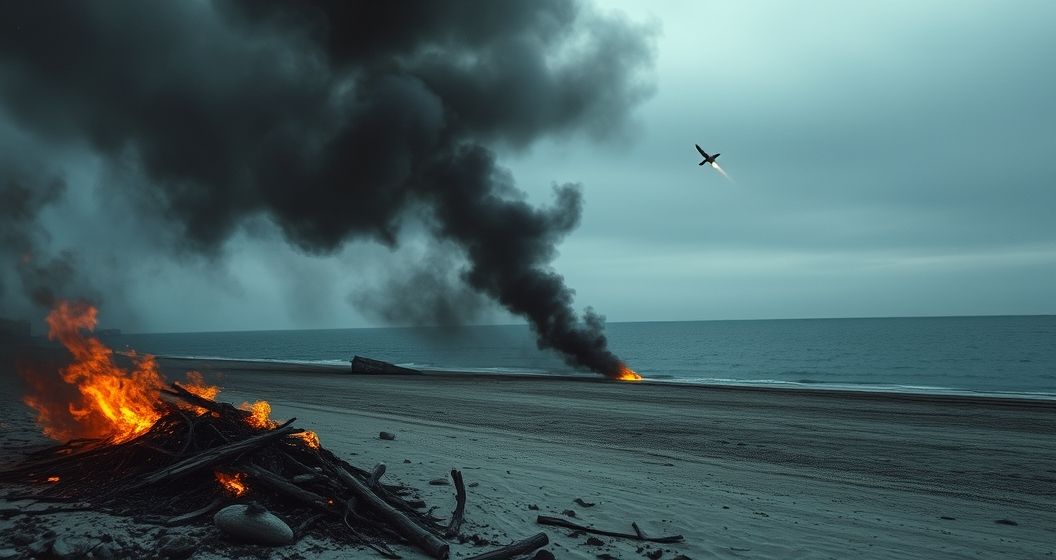
Tensions have sharply escalated after a Ukrainian missile strike on the city of Sevastopol in Crimea resulted in civilian casualties, prompting Moscow to directly blame the United States for the attack. Russian authorities claim the incident involved US-supplied Army Tactical Missile Systems (ATACMS) and stated that Washington bears direct responsibility for the loss of life, signaling a dangerous new phase in the ongoing conflict.
Details of the Sevastopol Attack
According to Russia’s Ministry of Defence, Ukrainian forces launched five ATACMS missiles, four of which were successfully intercepted by Russian air defense systems. However, the fifth missile’s warhead detonated in mid-air over a coastal area, scattering cluster munitions over a crowded beach. The falling debris caused multiple casualties, including children, who were enjoying a public holiday weekend. Local officials immediately declared a state of emergency as medical teams responded to the incident.
The use of cluster munitions in a populated area has drawn significant attention. These weapons are controversial due to their indiscriminate nature, releasing smaller submunitions over a wide area. Russian officials have described the attack as a “terrorist act” and have vowed to respond. The incident underscores the devastating human cost of the conflict extending to areas previously considered relatively safe for civilians.
Moscow’s Direct Accusations
In a strongly worded statement, the Russian government asserted that the United States was a party to the attack. The Defence Ministry claimed that the flight paths for the ATACMS missiles were programmed by US specialists, based on American satellite intelligence. This assertion moves beyond accusing Washington of simply supplying weapons, instead alleging its direct operational involvement in targeting decisions. This claim dramatically raises the stakes, framing the strike as a joint US-Ukrainian operation.
Following the statement, Russia’s Foreign Ministry summoned the US ambassador to Moscow to issue a formal diplomatic protest. Officials warned that such actions would “not go unanswered” and that there would be definite consequences. This direct confrontation places diplomatic relations, already at a post-Cold War low, under even greater strain and increases the risk of a broader, more direct conflict between the two nuclear powers.
The Role of Western-Supplied Weapons
The attack highlights the growing impact of long-range, precision-guided weapons supplied to Ukraine by its Western partners. Recently, Washington and other NATO allies granted Ukraine permission to use their weapons to strike targets within territory that Russia considers its own, including Crimea, which it annexed in 2014. This policy shift was intended to help Ukraine disrupt Russian military logistics and assembly points behind the front lines.
However, Moscow has consistently warned that it views the provision of such advanced weaponry, and the permission to use it on Russian territory, as a major escalation. Russia argues that these actions make NATO countries de facto participants in the conflict. The Sevastopol incident will almost certainly be used by Moscow to reinforce this narrative both domestically and internationally, portraying Russia as a victim of Western aggression.

