
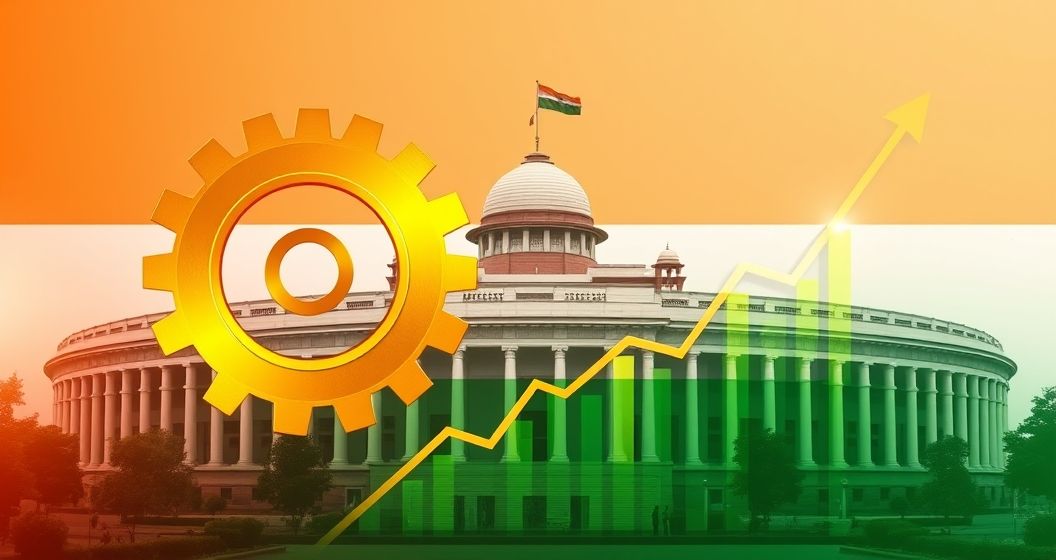
India is navigating a significant political transition as Narendra Modi secures a historic third consecutive term as Prime Minister. However, the new government operates under a different dynamic, relying on the National Democratic Alliance (NDA) coalition. This shift marks a pivotal moment in the nation’s governance, coinciding with a positive economic forecast from the country’s central bank that signals stability amidst political changes.
A New Era of Coalition Politics
Narendra Modi’s swearing-in ceremony marks his place in history alongside Jawaharlal Nehru as the only leaders to win three successive terms. The ceremony was attended by leaders from neighbouring countries, signalling a continuity in foreign policy. The key change this term is the Bharatiya Janata Party (BJP) lacking an outright majority on its own, making coalition partners like the Telugu Desam Party (TDP) and Janata Dal (United) (JD(U)) crucial for legislative stability.
The formation of the new cabinet reflects this coalition reality. Portfolios have been carefully distributed to accommodate key allies, ensuring the government’s stability. Analysts are closely watching how this power-sharing arrangement will influence policy decisions, particularly on contentious issues. The need for consensus-building will be paramount for the NDA government as it embarks on its third term, balancing the BJP’s core agenda with the regional priorities of its partners.
Economic Outlook Remains Strong
Adding a layer of confidence to the new administration, the Reserve Bank of India (RBI) recently announced its monetary policy update. The central bank decided to keep the repo rate unchanged at 6.5 per cent for the eighth consecutive time, indicating a cautious but steady approach to managing inflation. This decision was largely expected by markets and is aimed at supporting sustainable economic growth while keeping inflation in check.
More significantly, the RBI revised its gross domestic product (GDP) growth forecast for the current fiscal year upwards to 7.2 per cent from a previous estimate of 7 per cent. This optimistic projection is based on improving rural demand and steady urban consumption. The strong economic outlook provides a favourable backdrop for the new government, offering a stable foundation to pursue its economic and developmental goals in the coming years.
Political Tensions and High-Profile Incidents
While the focus is on government formation, the political atmosphere remains charged. A recent incident involving newly elected Member of Parliament and actress Kangana Ranaut has drawn significant attention. Ranaut was allegedly slapped by a Central Industrial Security Force (CISF) constable at Chandigarh airport. The incident has sparked a widespread debate on security protocols for public figures and the underlying social tensions in the country.
The constable involved has been suspended, and an investigation is underway. She reportedly acted due to comments Ranaut made during the farmers’ protests. This event highlights the deep-seated divisions on certain social and political issues. It serves as a reminder that beyond the corridors of power in Delhi, the government must also navigate complex public sentiments and ensure law and order across the nation.
Navigating the Path Forward
As the new government takes charge, its primary challenge will be to manage the intricacies of a coalition while pushing forward with its economic agenda. The strong GDP forecast provides a tailwind, but addressing political sensitivities and ensuring social harmony will be equally critical. The coming months will reveal how effectively the NDA can balance these diverse priorities to deliver on its promises to the electorate.
