
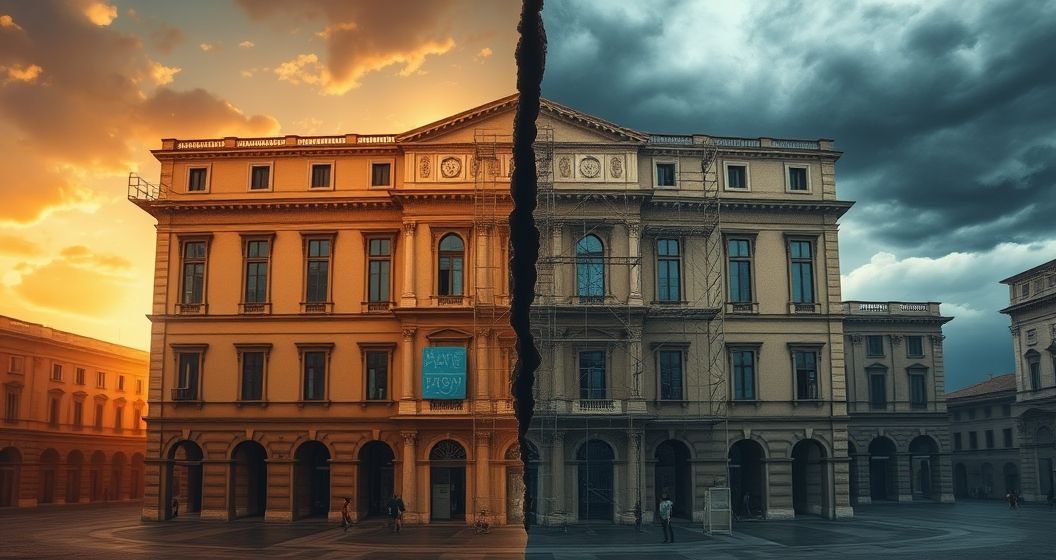
The Italian government has introduced a new decree, known as ‘Salva-casa’ (Save Homes), aimed at regularising minor building irregularities in private properties. Championed by Infrastructure Minister Matteo Salvini, the measure is designed to simplify property sales and renovations for millions of homeowners. However, the proposal has ignited significant political controversy, with opposition parties and critics arguing it amounts to a backdoor building amnesty that could undermine urban planning regulations and reward illegal practices.
Understanding the ‘Salva-Casa’ Proposal
At its core, the decree seeks to address widespread minor non-conformities found in many Italian homes. These often include small discrepancies between the property’s actual state and its official floor plan, such as an internal wall moved, a window altered, or an awning installed without the proper permits. Such issues can block or complicate property sales and access to renovation loans. The government argues that this measure will free up the real estate market and provide relief to citizens entangled in bureaucratic complexities.
The proposal introduces a mechanism for homeowners to rectify these minor infractions by paying a fine, the amount of which would be proportional to the extent of the irregularity. Proponents claim this is not a general amnesty, as it is limited to minor deviations and does not apply to major structural violations or buildings constructed in areas with landscape or environmental restrictions. The primary goal, they state, is to bring a vast number of properties into full legal compliance, boosting the construction sector in the process.
The Heart of the Controversy
Despite the government’s assurances, the decree has drawn sharp criticism from opposition parties, urban planners, and environmental groups. The central accusation is that the ‘Salva-casa’ decree is a form of condono edilizio, or building amnesty, a tool historically used in Italy that critics say encourages illegal construction. They argue that by allowing irregularities to be regularised through a simple payment, the state sends a message that rules can be bent, potentially leading to a decline in respect for building codes in the future.
Critics also raise concerns about the potential impact on urban landscapes and safety. They fear that the measure could legitimise work done without proper technical oversight, creating a precedent that weakens the authority of municipal planning offices. Furthermore, there is a debate over fairness, as opponents argue the decree benefits those who have disregarded regulations while penalising citizens who have followed the correct, often costly and time-consuming, legal procedures for their property modifications.
Next Steps and Potential Impact
The ‘Salva-casa’ decree must now navigate the parliamentary process for conversion into law, where it is expected to face a contentious debate and potential amendments. The final version will determine the true scope and limitations of the measure. If passed, it could have a significant short-term impact on the real estate market, potentially unlocking thousands of stalled property transactions. However, the long-term consequences for Italy’s urban planning discipline and the rule of law remain a central point of contention in this unfolding political and social issue.


