
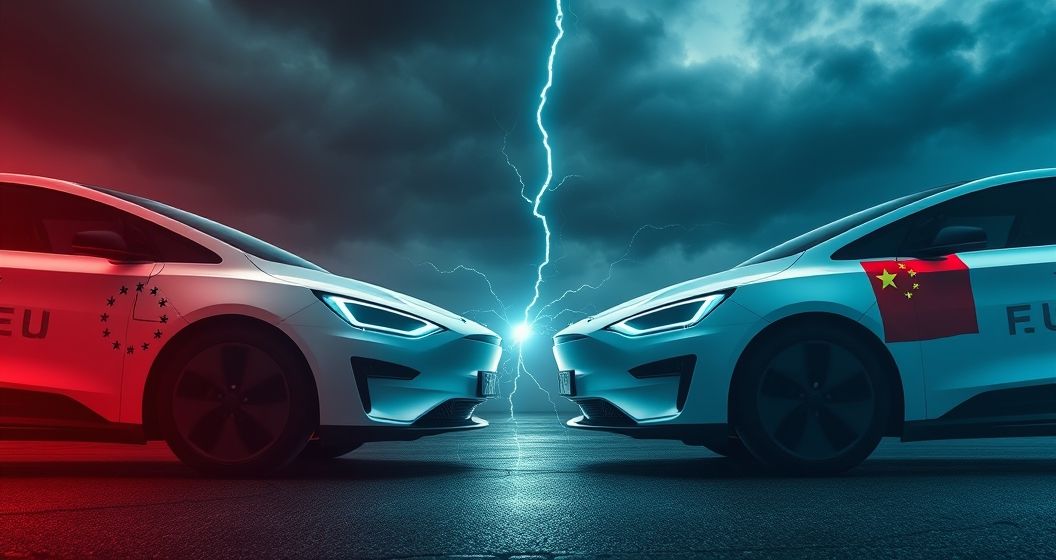
The European Union and China are on a collision course over trade, following Brussels’ decision to impose significant new tariffs on imported Chinese electric vehicles (EVs). The move, aimed at countering what the EU calls unfair state subsidies, has been met with strong condemnation from Beijing. This escalating dispute threatens to disrupt global supply chains and has ignited fears of a wider trade war between the two economic giants, placing industries from automotive to agriculture on high alert.
Brussels Justifies Tariffs on Unfair Competition
The European Commission announced provisional duties of up to 38.1% on Chinese EVs, arguing that an investigation found “unfair subsidisation” in China’s EV value chain. Officials in Brussels claim these subsidies allow Chinese manufacturers to sell vehicles at artificially low prices, undercutting European competitors and threatening jobs within the bloc. The tariffs are designed to level the playing field and protect the EU’s domestic automotive industry from a surge in low-cost imports.
These measures are not uniform and will vary depending on the level of cooperation from the Chinese companies during the investigation. The EU has stressed that the goal is not to close its market but to ensure fair competition. However, the decision has been criticized by some within Europe, particularly German automakers who have significant operations and sales in China and fear retaliatory actions.
Beijing’s Response: A Vow to Retaliate
China’s Ministry of Commerce swiftly denounced the EU’s decision, labeling it a “blatant act of protectionism” that lacks factual and legal basis. Beijing has accused the EU of weaponizing trade issues and has vowed to take all necessary measures to defend the legitimate rights and interests of its companies. The Chinese government denies the allegations of unfair subsidies, stating its EV industry’s success is built on innovation and robust market competition.
As a first concrete step, Beijing has launched an anti-dumping investigation into pork imports from the European Union. This move is widely seen as a direct retaliation targeting key EU agricultural exports. Analysts warn that this could be the first of many such measures, potentially affecting European luxury goods, wine, and dairy products if the dispute continues to escalate, creating significant economic uncertainty.
Global Economic Implications and the Path Forward
The standoff carries substantial risks for both economies. For the EU, a trade war could harm its major industries that rely heavily on the Chinese market. For China, it could hinder the global expansion of its leading technology and manufacturing firms. The dispute also creates a precarious situation for global automakers and consumers, who are likely to face higher prices and fewer choices as a result of the tariffs and counter-tariffs.
Despite the heated rhetoric, both sides have left a narrow window for negotiation before the tariffs are finalized. Diplomats and trade officials are expected to engage in intense discussions to find a resolution. The outcome of these talks will be critical in determining whether the two economic superpowers can de-escalate the situation or if they are heading toward a damaging and prolonged trade conflict with far-reaching consequences.

