
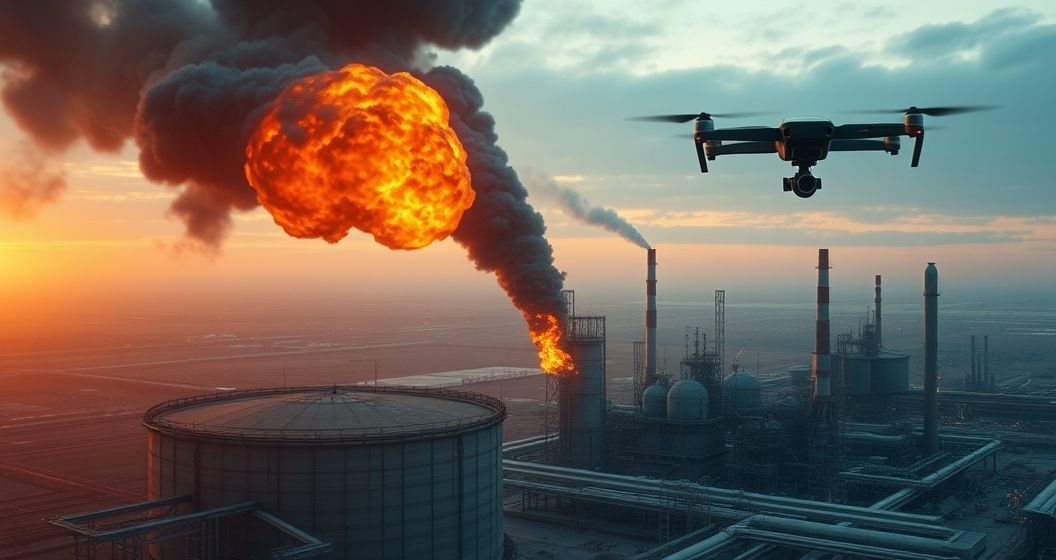
A significant long-range drone attack has struck major industrial facilities deep inside Russia, targeting sites in the Republic of Tatarstan. The strikes on installations in Yelabuga and Nizhnekamsk, located more than 1,200 kilometers from the Ukrainian border, represent a new phase in the conflict, demonstrating an expanded operational reach and a strategic focus on Russia’s industrial and military infrastructure.
An Unprecedented Strike Deep in Russian Territory
The attack’s location is its most notable feature. Tatarstan has been considered a secure rear area, far from the front lines. The ability to successfully target assets this deep within Russian territory signals a substantial advancement in long-range unmanned aerial vehicle (UAV) capabilities. This development challenges previous assumptions about the vulnerability of critical infrastructure located far from the conflict zone, forcing a reassessment of air defense strategies across a much wider geographic area.
Industrial and Energy Infrastructure Targeted
Initial reports indicate the drones targeted two key locations. One strike hit the Alabuga Special Economic Zone near Yelabuga, which reportedly houses a facility for assembling Shahed-type drones used by Russian forces. Such a strike would be aimed directly at disrupting the supply chain for one of Russia’s key aerial weapons. The second target was a major oil refinery in the city of Nizhnekamsk, one of the largest in the country. This continues a pattern of attacks aimed at crippling Russia’s energy sector.
The Economic and Military Implications
Targeting industrial and energy hubs is a calculated strategy designed to inflict direct economic pain and hamper the war effort. Attacks on refineries can disrupt fuel production for both military and civilian use, potentially impacting revenue from oil exports. Similarly, striking a drone production facility aims to degrade Russia’s capacity to conduct its own aerial campaigns. These strikes are less about territorial gains and more about attrition and economic warfare.
Official Responses and Aftermath
Russian officials in Tatarstan confirmed the attacks, stating that emergency services were responding to the incidents. Reports from the region mentioned that several people were injured in the strike on the Yelabuga facility. Kremlin officials condemned the strikes as acts of terrorism. While Ukraine typically does not officially claim responsibility for specific attacks on Russian soil, officials have openly stated their goal of diminishing Russia’s military and industrial capabilities through such actions.
This long-range drone operation underscores a strategic shift in the conflict. By successfully striking high-value industrial targets far from the front lines, the attackers have demonstrated a capacity to project power deep into Russian territory, signaling that few regions with critical infrastructure can be considered entirely safe. The event is likely to have significant repercussions for Russia’s domestic security and air defense posture.