
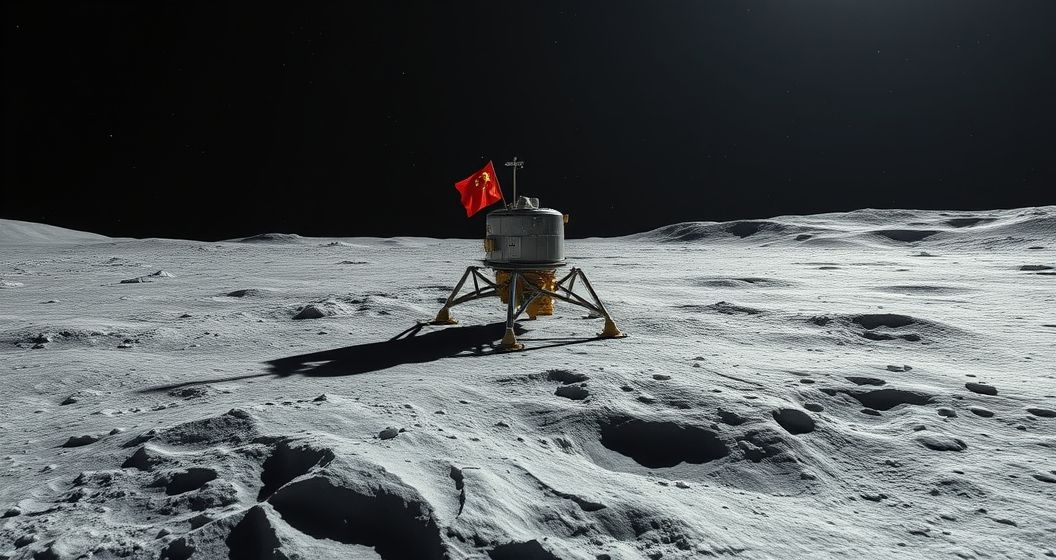
China’s ambitious space programme has achieved another significant milestone, with its Chang’e-6 probe successfully landing on the far side of the Moon. The uncrewed mission aims to collect the first-ever rock and soil samples from this largely unexplored region. This accomplishment reinforces China’s position as a leading power in space exploration and sets the stage for future lunar endeavours, including potential crewed missions.
A Groundbreaking Mission in Lunar Exploration
The China National Space Administration (CNSA) confirmed the successful touchdown in the vast South Pole-Aitken Basin, one of the largest known impact craters in the solar system. This area is of immense interest to scientists because it may contain crucial clues about the Moon’s formation and early history. Landing on the far side presents unique challenges, as it is never visible from Earth, making direct communication impossible.
To overcome this obstacle, the mission relies on the Queqiao-2 relay satellite, which was launched earlier to orbit the Moon and facilitate communication between the lander and ground control. The success of this landing is a testament to the precision and reliability of China’s deep-space navigation and communication technologies, marking a major leap forward in its capabilities.
The Complex Landing and Collection Process
The descent and landing sequence was a highly automated and complex procedure. The probe had to autonomously navigate treacherous terrain, using its onboard sensors to detect and avoid craters and boulders before selecting a safe landing spot. The entire process, lasting several minutes, was a critical test of the probe’s advanced guidance and control systems, which performed flawlessly to ensure a soft landing.
Following the landing, the Chang’e-6 probe will begin its surface operations. The mission plan allocates a limited time for the collection of approximately two kilograms of lunar material. It will use a robotic arm to scoop up surface soil and a drill to collect subsurface samples. This dual approach aims to provide a comprehensive geological record of the landing site for analysis back on Earth.
Implications for China’s Space Ambitions
This mission is a key component of China’s long-term lunar exploration strategy. The samples gathered by Chang’e-6 are expected to provide unprecedented insights into the Moon’s geology and evolution, potentially answering fundamental questions about our solar system. The technological expertise gained from this complex operation will be invaluable for future missions.
The success of Chang’e-6 solidifies China’s standing in the new era of space exploration. The country is actively planning future lunar missions, including the establishment of a permanent international lunar research station in the coming decade. Each successful mission brings China closer to its ultimate goal of sending astronauts to the Moon and establishing a sustained human presence there.

