
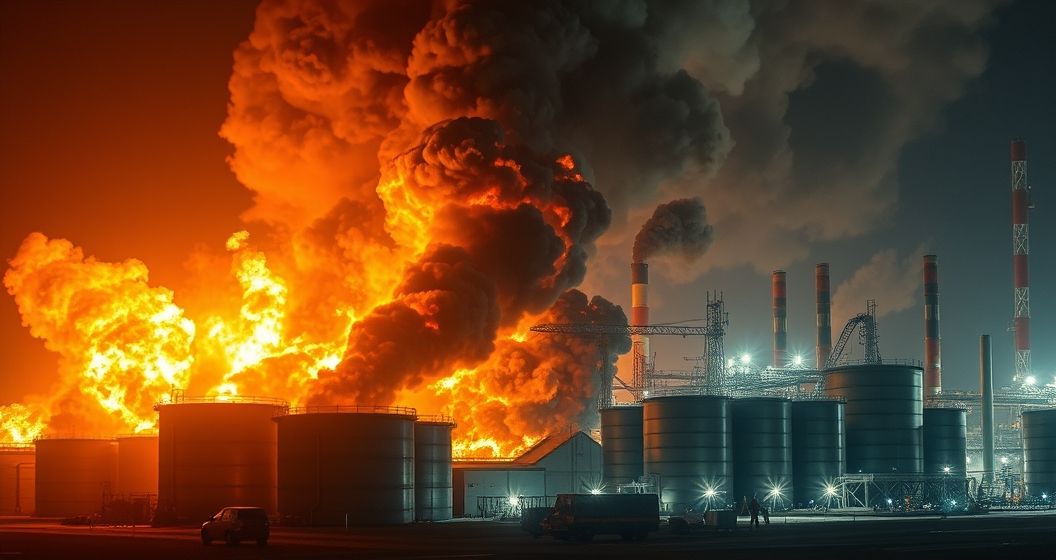
A major fire has engulfed an oil storage facility in the Russian city of Azov, located in the Rostov region, following what local officials described as a Ukrainian drone attack. Emergency services were dispatched to battle the massive blaze, which consumed several fuel tanks and spread over a large area. The incident marks another significant strike against Russia’s critical energy infrastructure, aimed at disrupting its military logistics and fuel supply chains far from the front lines of the conflict.
Details of the Drone Strike and Fire
According to the regional governor, Vasily Golubev, the attack occurred in the early hours, with several drones targeting the oil terminal. The resulting explosions ignited storage tanks containing petroleum products, leading to a rapidly spreading fire. The Russian Ministry of Emergency Situations reported that the blaze covered an area of approximately 3,200 square meters. More than 200 firefighters and specialized equipment, including a dedicated fire train, were deployed to contain the fire and prevent it from spreading to other nearby tanks.
Local residents reported hearing multiple explosions before the fire became visible, sending a massive column of black smoke into the sky. Officials have assured the public that there is no immediate threat to the city’s population and have taken air quality samples to monitor for pollutants. Despite the scale of the fire, preliminary reports indicated no casualties, which was a primary concern for the emergency response teams working at the volatile scene.
Official Responses and Responsibility Claims
While Russian officials were quick to attribute the incident to a Ukrainian drone strike, Ukrainian authorities have not formally commented, in line with their typical policy regarding attacks on Russian soil. However, sources within Ukraine’s security services have reportedly confirmed their involvement to Ukrainian media outlets. The unnamed sources stated that the operation was carried out by the Security Service of Ukraine (SBU) and was intended to complicate the supply of fuel for the Russian military.
These claims suggest a deliberate and strategic operation. The SBU source reportedly described the targeted facility as a key logistical hub for supplying fuel to Russian troops. This aligns with a broader pattern of Ukrainian attacks aimed at degrading Russia’s ability to sustain its military operations by striking at its economic and logistical weak points deep within its own territory.
Targeting Russia’s Energy Infrastructure
The attack on the Azov oil depot is not an isolated event but part of a sustained Ukrainian campaign to target Russian energy facilities. In recent months, Ukraine has increasingly used long-range drones to strike refineries, oil terminals, and fuel depots across Russia. These operations serve a dual purpose: they disrupt the fuel supply essential for Russian military vehicles and aircraft, and they inflict significant economic damage by interrupting valuable exports.
This strategy forces Russia to divert critical air defense systems away from the front lines to protect its vast industrial and energy infrastructure. The success of such strikes highlights the vulnerability of these facilities and demonstrates Ukraine’s growing technological and operational capabilities in conducting complex, long-range missions. The campaign aims to create persistent pressure on Russia’s war economy and its ability to project power.


