
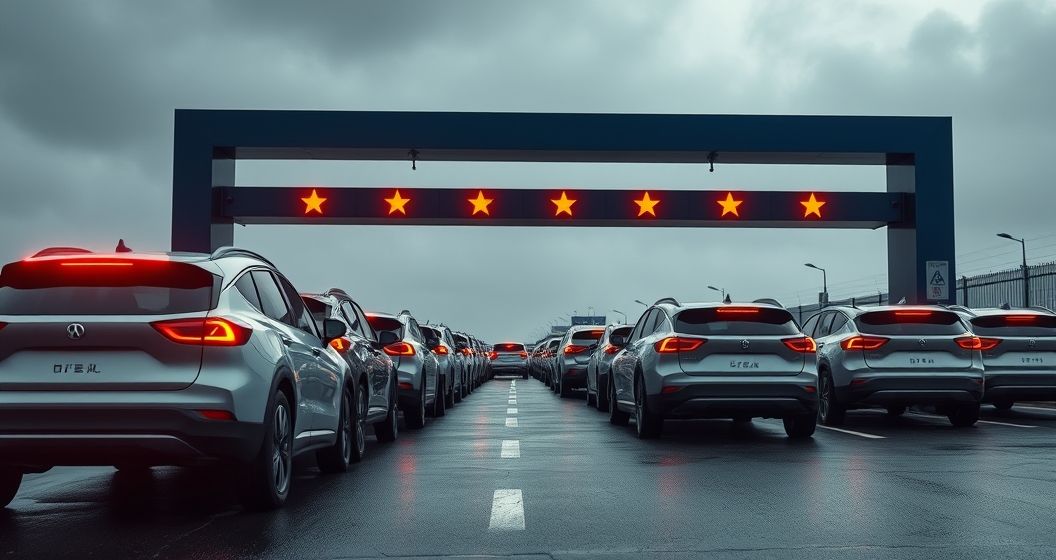
The European Commission has announced plans to impose significant provisional tariffs on electric vehicles (EVs) imported from China. This move follows a months-long investigation into what the EU describes as unfair state subsidies benefiting Chinese manufacturers. The decision marks a major escalation in trade tensions between Brussels and Beijing, threatening to disrupt the rapidly growing global EV market and potentially sparking a wider trade conflict.
Probe Cites Unfair Subsidies
The core of the EU’s decision rests on its preliminary findings that China’s battery-electric vehicle value chain benefits from “unfair subsidisation.” According to the Commission, these subsidies are causing a threat of economic injury to EV producers within the European Union. The investigation was launched to level the playing field for European automakers, who have struggled to compete with the lower prices of their Chinese counterparts, which have been rapidly gaining market share across the continent.
These protective measures are intended to safeguard the future of the European automotive industry, a critical sector for the region’s economy. Officials argue that without such intervention, local manufacturers could face irreversible damage from state-supported competition that distorts the market.
Details of the New Levies
The tariffs will vary depending on the specific manufacturer and their level of cooperation with the EU’s investigation. The proposed duties will be applied on top of the existing 10% tariff on all imported cars.
Manufacturer-Specific Rates
Leading Chinese automakers will face different rates. BYD, a major player in the global EV market, is set to receive a 17.4% tariff. Geely, which owns Volvo, will face a 20% duty. SAIC, a state-owned enterprise, has been hit with the highest rate of 38.1%. Other EV producers in China that cooperated with the investigation but were not individually sampled will be subject to an average duty of 21%. Companies that did not cooperate face the full 38.1% rate.
China’s Response and Potential Retaliation
Beijing has strongly condemned the EU’s move, labeling it as a “blatant act of protectionism.” The Chinese Ministry of Commerce stated that the decision lacks factual and legal basis and urged the EU to correct its “wrongdoing.” Officials have warned that China will take all necessary measures to firmly defend the legitimate rights and interests of its companies. This has fueled speculation about potential retaliatory tariffs from China targeting European goods, with sectors like agriculture and luxury automobiles seen as possible targets.
Global Market Implications
The imposition of these tariffs creates significant uncertainty for the global auto industry and could impact consumers. The move could slow down the adoption of electric vehicles by increasing their prices in Europe, potentially complicating the region’s climate goals. It also highlights a growing trend of protectionism among Western nations concerned about China’s industrial dominance in key green technologies, following a similar, more severe tariff hike by the United States. The situation remains fluid as discussions between the EU and Chinese authorities continue.


