
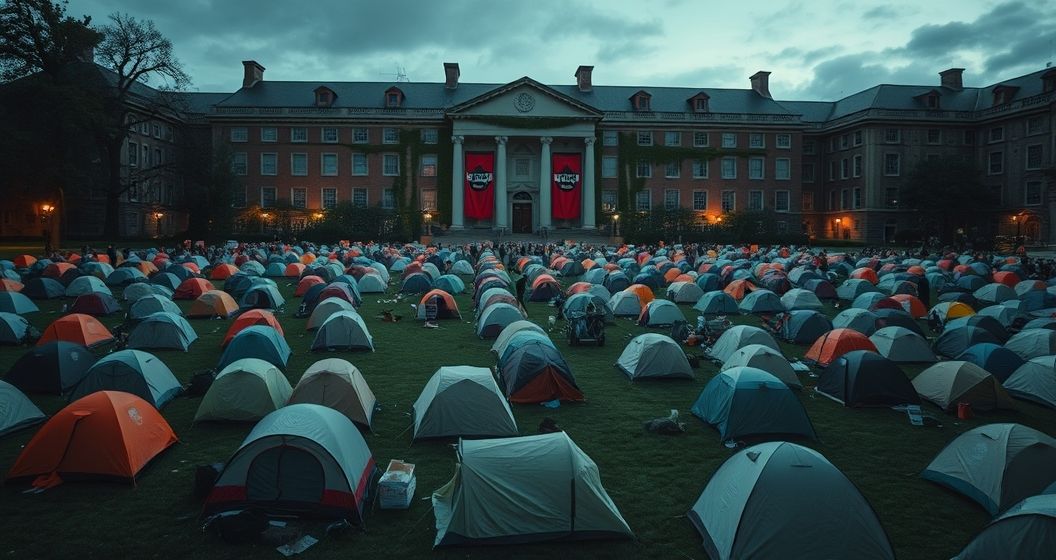
Pro-Palestinian demonstrations are expanding across university campuses in the United States, creating significant challenges for administrators and law enforcement. What began as a localized protest has evolved into a nationwide movement, with students establishing encampments and demanding that their institutions divest from companies with financial ties to Israel. The growing unrest has led to hundreds of arrests and sparked a contentious national debate over free speech and campus safety.
The Flashpoint at Columbia University
Columbia University in New York has become the epicenter of the current wave of student activism. Protesters established a “Gaza Solidarity Encampment” on the university’s main lawn, prompting a swift response from the administration. After negotiations failed, university officials authorized the New York Police Department to clear the encampment, resulting in over 100 arrests. This action, however, did not quell the movement but instead appeared to galvanize students at other institutions to launch similar protests in solidarity.
A Nationwide Movement Emerges
Following the events at Columbia, similar encampments and demonstrations have appeared at dozens of other prominent universities. Institutions such as Yale University, New York University, the Massachusetts Institute of Technology (MIT), and the University of Southern California (USC) are now grappling with their own protests. At USC, officials canceled the main stage graduation ceremony, citing new safety measures, a decision that has drawn criticism from students and alumni alike. The widespread nature of these events indicates a coordinated and deeply felt student movement.
Core Demands of the Protesters
The central demand uniting these disparate protests is divestment. Student groups are calling on their universities to disclose all financial holdings and to sever ties with corporations they allege are complicit in the conflict in Gaza. They argue that their tuition fees should not be invested in companies that profit from military actions. Beyond divestment, protesters are also calling for greater academic freedom to discuss the Palestinian cause and for their universities to issue statements condemning Israel’s military operations.
Navigating a Complex Challenge
University administrations face a difficult balancing act. They are under immense pressure to protect students’ rights to free speech and assembly while also ensuring a safe and non-disruptive campus environment for all students. Some university leaders have chosen to negotiate with protesters, while others have resorted to disciplinary action and law enforcement intervention. The varied responses highlight the complexity of managing campus tensions amid a deeply polarizing geopolitical conflict that shows no signs of abating.
As the academic year nears its end, the future of these protests remains uncertain. The ongoing demonstrations have placed universities at the forefront of a national conversation about activism, investment ethics, and the fundamental role of higher education in society. The situation continues to develop, with the potential for further escalation as commencement ceremonies approach.