
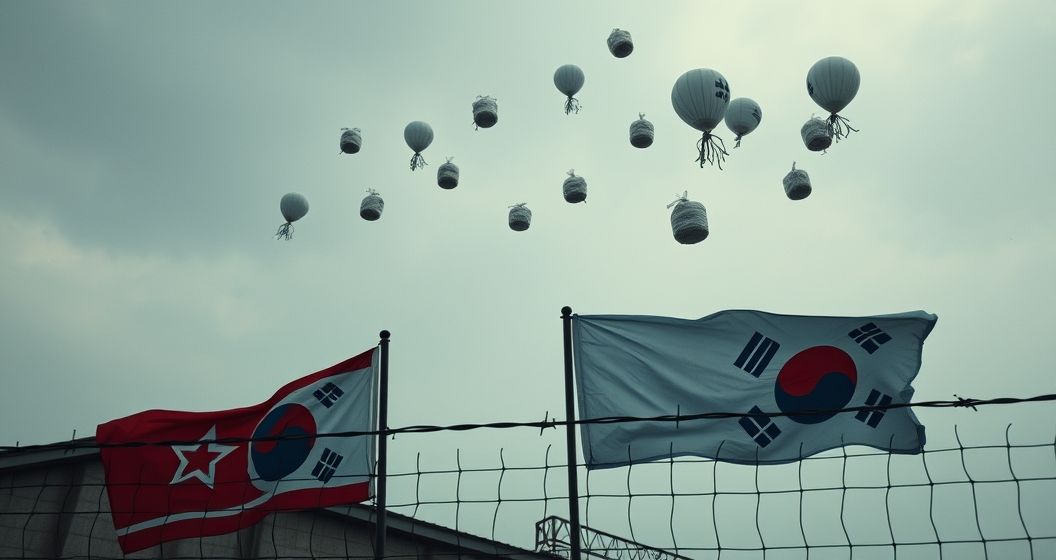
South Korea has announced the full suspension of the 2018 inter-Korean military agreement, a significant move escalating tensions on the peninsula. This decision comes as a direct response to North Korea sending hundreds of balloons filled with trash and manure across the border. The government has framed the suspension as a necessary measure to protect national security and enable a more robust response to ongoing provocations, which have also included GPS jamming attacks.
Pyongyang’s Unconventional Barrage
Over the past week, North Korea has launched nearly a thousand balloons carrying waste materials such as cigarette butts, cloth scraps, waste paper, and excrement into South Korean territory. The campaign has caused minor property damage and widespread public concern. North Korea claims these actions are a direct retaliation against South Korean activists who frequently send balloons carrying anti-Pyongyang leaflets, USB drives with K-pop, and food items into the North.
While no hazardous materials have been found, the sheer volume of the balloon launches has been deemed a serious provocation by Seoul. The South Korean military has been on high alert, deploying chemical, biological, and radiological response teams to safely inspect and collect the debris. In addition to the balloons, North Korea has reportedly conducted GPS jamming attacks near the western sea border, disrupting maritime and fishing operations.
The End of a Landmark Agreement
The 2018 Comprehensive Military Agreement was a cornerstone of the brief period of diplomacy between the two Koreas. Signed during a summit between former South Korean President Moon Jae-in and North Korean leader Kim Jong Un, it aimed to reduce conventional military threats. Key provisions included establishing no-fly zones, removing guard posts from the Demilitarized Zone (DMZ), and halting all hostile acts, including military drills and propaganda broadcasts along the border.
By suspending the pact, South Korea can now resume military training exercises near the demarcation line and restart loudspeaker propaganda broadcasts aimed at the North. These broadcasts, which blare news, criticism of the Pyongyang regime, and K-pop music, are a source of extreme irritation for North Korea and were halted under the 2018 deal. The South Korean National Security Council stated that the agreement had been effectively nullified by North Korea’s persistent violations.
Implications for Regional Security
The suspension of the military pact removes a critical buffer that was designed to prevent accidental clashes along one of the world’s most heavily fortified borders. Without the agreement’s constraints, both sides are now free to ramp up military activities, significantly increasing the risk of miscalculation and escalation. This development effectively returns inter-Korean relations to a state of heightened confrontation, erasing the diplomatic progress made several years ago.
Analysts fear this could lead to a cycle of tit-for-tat provocations. Seoul’s resumption of loudspeaker broadcasts will almost certainly trigger a strong, and potentially kinetic, response from Pyongyang. With communication channels between the two Koreas severed, the lack of de-escalation mechanisms further complicates an already volatile security environment on the peninsula.