
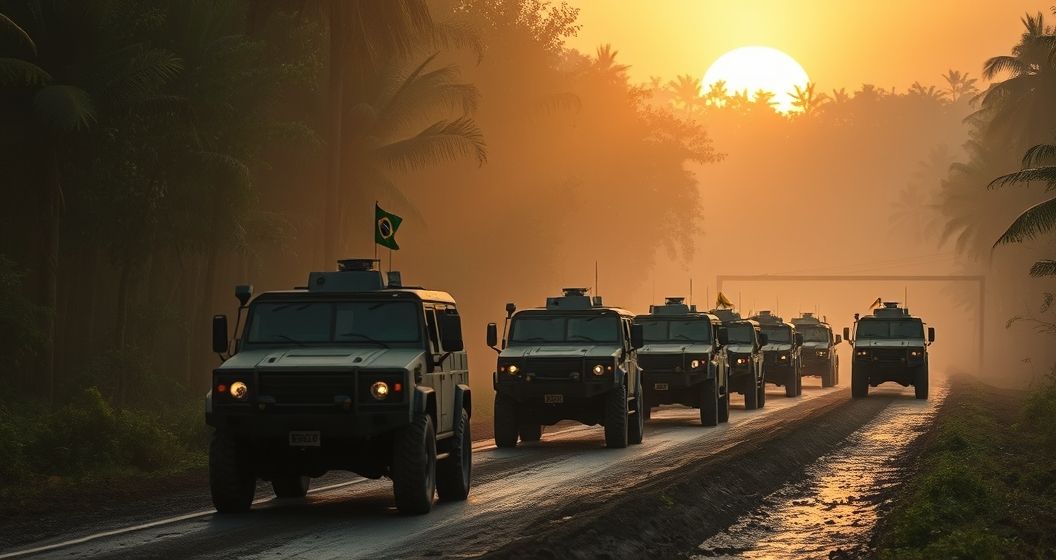
Brazil’s Ministry of Defence has initiated a significant reinforcement of its military presence along the border with Venezuela. This move comes in direct response to escalating tensions between Venezuela and Guyana over the disputed Essequibo region. The Brazilian government is taking precautionary measures to secure its northern frontier and prevent the conflict from spilling over into its territory, emphasizing a commitment to regional stability.
Strategic Military Buildup in Roraima
The focus of the military mobilization is the state of Roraima, which shares a border with both Venezuela and Guyana. The Brazilian Army is deploying additional troops and armored vehicles to the region. This includes increasing the contingent at the 1st Jungle Infantry Brigade and sending armored combat vehicles to bolster surveillance and defense capabilities along the critical border crossing near Pacaraima, a key entry point from Venezuela.
These reinforcements are described by military officials as a preventative action. The primary goal is to enhance monitoring capabilities and ensure that national sovereignty is protected. By positioning these assets, Brazil sends a clear message that its territory will not be used as a staging ground for any potential military action, ensuring the integrity of its borders is maintained amid the regional uncertainty and posturing.
A Call for Dialogue and De-escalation
While military preparations are underway, Brazil’s diplomatic channels are actively working to de-escalate the situation. President Luiz Inácio Lula da Silva’s administration has emphasized its commitment to a peaceful resolution. Brazilian diplomats are engaging with both Venezuelan and Guyanese counterparts, urging them to return to dialogue and avoid any actions that could lead to open conflict in a region known for its peaceful relations.
The Essequibo Dispute at the Core
The tension stems from Venezuela’s long-standing claim over the Essequibo region, which constitutes about two-thirds of Guyana’s territory. The area is rich in oil and other natural resources, with recent offshore discoveries intensifying the dispute. A recent referendum in Venezuela, which supported the claim to annex the territory, has significantly heightened concerns across the continent, prompting neighboring countries like Brazil to respond with heightened vigilance.
Broader Implications for Regional Stability
The situation poses a significant threat to the stability of South America, a continent that has largely been free of interstate wars for decades. A conflict between Venezuela and Guyana could trigger a major humanitarian crisis, potentially leading to a new wave of refugees seeking safety in Brazil and other neighboring nations. It also threatens to disrupt regional cooperation and economic integration efforts that are vital for collective progress.
Ultimately, Brazil’s strategy is twofold: demonstrating military readiness to deter any aggression while simultaneously pursuing a diplomatic path to peace. The government’s actions reflect a delicate balancing act aimed at safeguarding national interests and promoting stability in a suddenly volatile part of the continent. The coming weeks will be crucial in determining whether dialogue or confrontation prevails.