
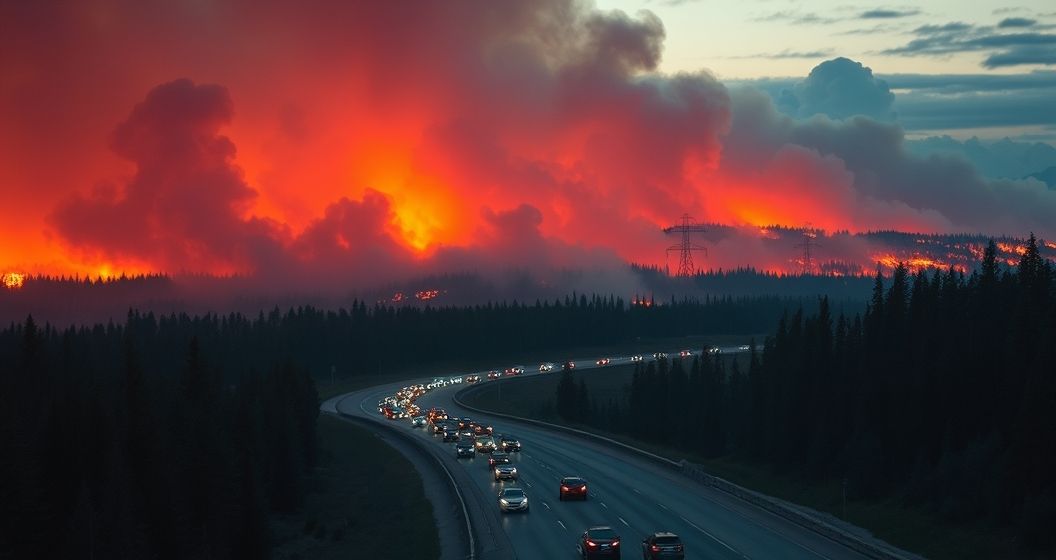
A series of aggressive wildfires is currently sweeping across parts of British Columbia and Alberta, forcing thousands of residents from their homes. Emergency crews are battling multiple out-of-control blazes that have prompted evacuation orders and states of emergency in several communities. The situation remains volatile as shifting winds and dry conditions continue to challenge firefighting efforts across the region, creating a significant public safety crisis.
State of Emergency Declared
In response to the escalating threat, authorities have declared a state of local emergency in key areas. The Northern Rockies Regional Municipality in British Columbia, which includes the town of Fort Nelson, is under a full evacuation order. Similarly, an evacuation alert has been issued for parts of Fort McMurray in Alberta, a community that faced a devastating wildfire years ago. These declarations grant officials additional powers to manage the crisis and coordinate response efforts effectively.
The primary goal of these measures is to ensure the safety of residents and provide emergency responders with the resources they need. Officials are urging the public to stay informed through official channels and be prepared to leave at a moment’s notice. The rapid spread of the fires has made swift and decisive action essential to prevent loss of life and property in these vulnerable communities.
Major Fires Forcing Mass Evacuations
The Parker Lake fire near Fort Nelson in British Columbia has grown exponentially, fueled by strong winds and an abundance of dry fuel. This out-of-control blaze has been the primary driver behind the evacuation of approximately 4,700 people from the area. The fire’s proximity to the town has created a direct and immediate threat, leaving residents with little time to gather their belongings before fleeing to safety.
In Alberta, a separate wildfire burning southwest of Fort McMurray has placed the community on high alert. Memories of the 2016 disaster are still fresh, and authorities are taking no chances. The evacuation alert covers several suburban neighbourhoods, with officials closely monitoring the fire’s behaviour and its potential to move closer to populated areas. The combined evacuations in both provinces highlight the scale of the current wildfire emergency.
Widespread Air Quality Concerns
Beyond the immediate fire zones, thick smoke is causing significant air quality issues across Western Canada and beyond. Special air quality statements have been issued for large swaths of British Columbia, Alberta, and Saskatchewan, with smoke plumes even drifting into neighbouring US states. The haze has reduced visibility and poses a considerable health risk, particularly for vulnerable populations.
Health Risks from Wildfire Smoke
Health officials are advising people, especially children, the elderly, and those with pre-existing respiratory conditions, to remain indoors as much as possible. Wildfire smoke contains fine particulate matter that can penetrate deep into the lungs, causing irritation, coughing, and shortness of breath. Staying in places with filtered air and avoiding strenuous outdoor activity is highly recommended until the air quality improves.
The Response and Outlook
Hundreds of firefighters, supported by aircraft and heavy equipment, are working tirelessly to contain the blazes. However, the weather conditions remain a major obstacle. While some areas hope for rain, strong and unpredictable winds continue to fan the flames, making containment efforts extremely difficult. The focus remains on structural protection and establishing defensive lines to slow the fires’ advance toward communities. The situation is expected to remain critical until there is a significant change in the weather pattern.


