
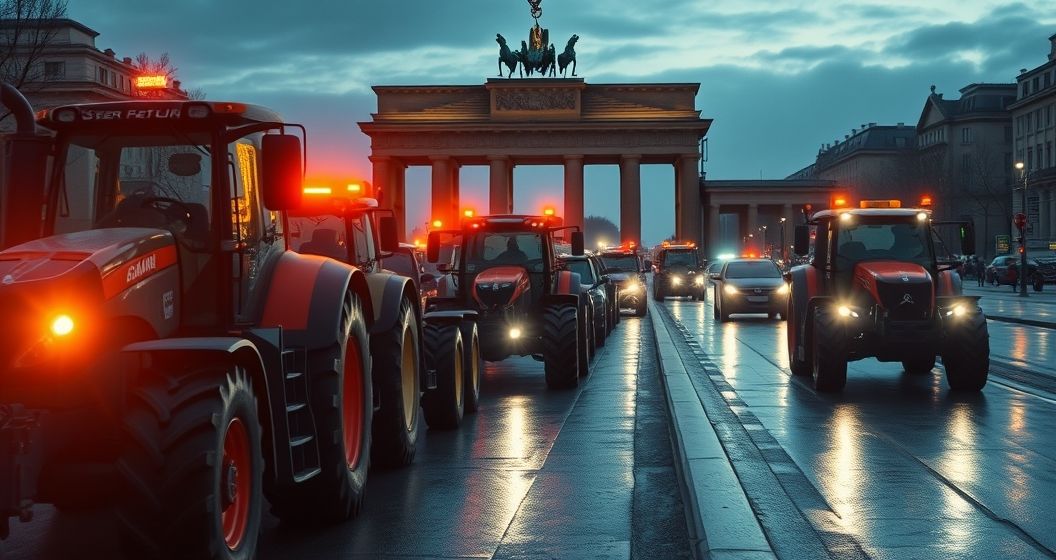
Germany is currently experiencing widespread disruption as farmers engage in nationwide protests against the government’s planned cuts to agricultural subsidies. The demonstrations, marked by convoys of thousands of tractors, have blocked major highways, city centers, and logistical hubs, creating significant challenges for commuters and supply chains. The protests represent a major challenge for Chancellor Olaf Scholz’s coalition government, which is already grappling with a difficult economic and political climate.
The Core of the Dispute: Agricultural Subsidies
The conflict was ignited by a government proposal to phase out crucial financial support for the agricultural sector. Specifically, the plan involved eliminating tax breaks on agricultural diesel and ending a vehicle tax exemption for farming equipment. These measures were introduced as part of an effort to fill a multi-billion-euro gap in the national budget, which emerged after a constitutional court ruling disrupted the government’s spending plans. For farmers, these cuts are seen as the final straw in a series of mounting financial pressures.
Farmers’ associations argue that the removal of the diesel subsidy would place an unbearable burden on their operations, making them less competitive against international rivals. They contend that the government is unfairly targeting the agricultural sector to solve its fiscal problems, ignoring the essential role farmers play in food security and rural economies. Despite the government partially retracting the proposals, the core issue of the diesel subsidy remains, fueling the ongoing demonstrations.
A Nation on Standstill: The Scale of Demonstrations
The scale of the protests has been extensive, with coordinated actions across all 16 German states. In Berlin, a massive convoy of tractors converged on the iconic Brandenburg Gate, bringing the capital’s traffic to a standstill. Similar scenes have unfolded in major cities like Hamburg, Munich, and Cologne, where farmers used their vehicles to create blockades on key arterial roads and motorway access points. The protests have been largely peaceful but highly disruptive, impacting daily life for millions.
The strategic targeting of distribution centers for major supermarket chains has also raised concerns about potential food shortages. While the government and retail associations have assured the public that supplies remain stable for now, prolonged blockades could pose a genuine threat to the country’s intricate logistics network. The visual impact of these tractor convoys has dominated media coverage and highlighted the deep-seated anger within the farming community.
Political Fallout and an Uncertain Future
The protests have placed immense pressure on the ruling coalition of Social Democrats (SPD), Greens, and Free Democrats (FDP). The government’s initial hardline stance has softened, with officials now seeking dialogue with farming representatives. However, a resolution remains elusive as the farmers’ unions demand a complete reversal of the planned cuts. The situation has also created a political opening for opposition parties and has drawn concerns about extremist groups attempting to co-opt the movement for their own purposes.
As the standoff continues, the future of Germany’s agricultural policy hangs in the balance. The conflict underscores the delicate balance between fiscal responsibility and supporting a vital economic sector. The outcome will not only determine the financial viability of thousands of farms but also serve as a significant test of the stability and responsiveness of the current government.
