
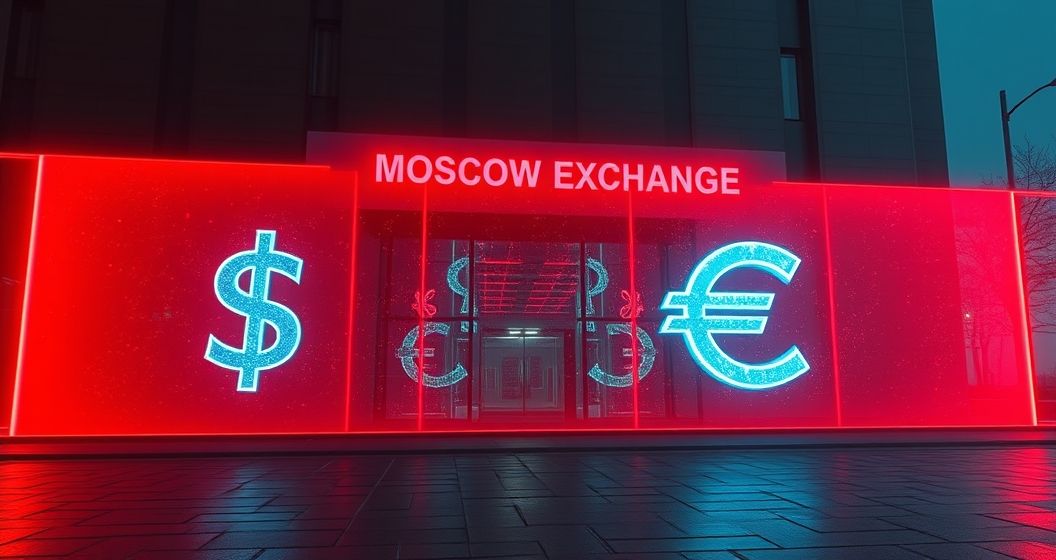
The Moscow Exchange (MOEX) has announced the immediate suspension of trading in the US dollar and the euro. This decisive action comes in direct response to a new round of sanctions imposed by the United States. The move marks a significant escalation in financial pressure on Russia, effectively cutting off its main venue for centralized foreign currency trading and creating new challenges for its economy and financial markets.
Immediate Response to US Sanctions
The decision was triggered after the US Treasury Department added the Moscow Exchange and its key settlement agents, the National Clearing Centre (NCC) and the National Settlement Depository (NSD), to its sanctions list. By targeting the core infrastructure of Russia’s financial market, the sanctions aim to further isolate the country from the global financial system. The suspension applies to all instruments traded in US dollars and euros on the foreign exchange, precious metals, stock, money, and standardized derivatives markets.
In a statement, the exchange confirmed that the measure was taken “in order to comply with the requirements of the Central Bank of Russia.” This step effectively ends an era of organized, on-exchange currency trading for the two dominant global currencies, forcing businesses and individuals to rely on alternative methods for foreign exchange transactions. The immediate effect is increased uncertainty for importers, exporters, and ordinary citizens who rely on a stable and predictable exchange rate.
The Central Bank’s New Mechanism
Russia’s Central Bank swiftly responded to the development, assuring the public that the move would not impact the availability of foreign currency. The regulator announced that official exchange rates for the ruble against the dollar and euro will now be determined using data from over-the-counter (OTC) trading and reporting from credit institutions. This new mechanism relies on direct bank-to-bank transactions rather than the centralized exchange system.
The Central Bank emphasized that all funds held in US dollars and euros in citizen and corporate accounts remain secure. It also stated that individuals and companies can continue to buy and sell these currencies through Russian banks. However, the shift to an OTC market is expected to lead to wider spreads between buying and selling prices, increasing transaction costs and potentially introducing more volatility into the market in the short term.
Long-Term Economic Implications
This suspension accelerates Russia’s strategic pivot away from Western currencies, a process often referred to as de-dollarization. For months, the Chinese yuan has been steadily gaining ground on the Moscow Exchange, recently surpassing the dollar as the most traded currency. The latest sanctions will undoubtedly cement the yuan’s dominant position and encourage further trade in the currencies of so-called “friendly” nations.
The move represents a new chapter in Russia’s economic isolation, forcing it to develop more resilient, self-sufficient financial systems. While the Central Bank aims to manage a smooth transition, the long-term consequences will likely include reduced efficiency in foreign trade operations and a more fragmented financial landscape. The ability of the Russian economy to adapt to this new reality will be a critical test of its resilience.