
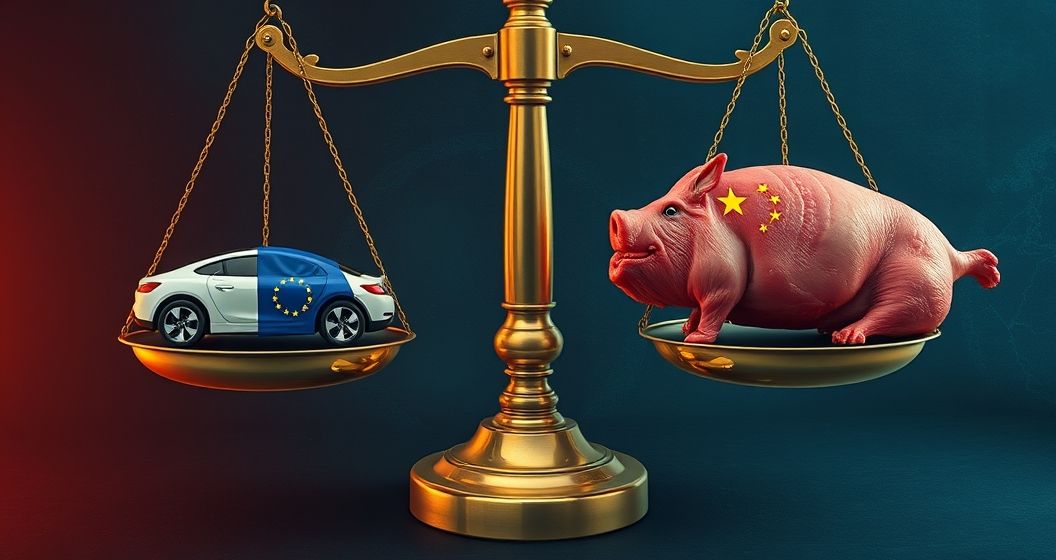
Trade tensions between China and the European Union are escalating, as Beijing launched an anti-dumping investigation into pork imports from the EU. This move is widely seen as a direct retaliation against the bloc’s recent decision to impose provisional tariffs on Chinese-made electric vehicles (EVs). The developing situation signals a potential for a broader trade dispute between two of the world’s largest economic partners, creating uncertainty across multiple industries.
The Spark: EU’s Electric Vehicle Tariffs
The conflict ignited after the European Commission announced its intention to levy additional duties of up to 38.1% on imported Chinese EVs. The Commission’s investigation concluded that China’s electric vehicle value chain benefits from “unfair subsidization,” which is causing a threat of economic injury to EU producers. These tariffs are scheduled to apply provisionally from early July unless a negotiated solution is reached with Chinese authorities.
European officials maintain that the goal is not to close the market but to ensure fair competition. However, the move has been met with significant opposition, not only from Beijing but also from within Europe. Major German automakers, who have substantial operations and sales in China, have expressed concerns that the tariffs could lead to a damaging trade war that would ultimately harm their businesses.
Beijing’s Calculated Response
In response, China’s Ministry of Commerce initiated an anti-dumping investigation into certain pork and pork by-products originating from the European Union. The probe follows a complaint filed by the China Animal Agriculture Association on behalf of the domestic pork industry. While Beijing has not explicitly linked the pork investigation to the EV tariffs, the timing is seen by analysts as a clear and targeted countermeasure.
A Warning Shot to European Agriculture
The choice of pork is strategic. The EU is the largest supplier of pork to China, with exports valued at billions of dollars annually. Countries like Spain, the Netherlands, and Denmark are major exporters and would be significantly impacted by any new duties. This targeted approach applies pressure on specific EU member states whose agricultural sectors rely heavily on the Chinese market, potentially creating internal division within the EU over its trade policy with China.
Broader Implications for Global Trade
This tit-for-tat exchange raises concerns about a deepening cycle of protectionism. Both sides have stated their preference for dialogue and negotiation to resolve the issues. Chinese officials have called on the EU to “correct its wrongdoings immediately” and return to a path of cooperation. Meanwhile, European leaders emphasize that they are open to discussions but will defend their industries from unfair trade practices.
The outcome of these disputes will have far-reaching consequences. For global supply chains, automakers, and agricultural producers, the uncertainty is a significant challenge. The coming weeks will be crucial in determining whether both sides can find a diplomatic off-ramp or if they are headed for a more protracted and economically damaging trade conflict.


