
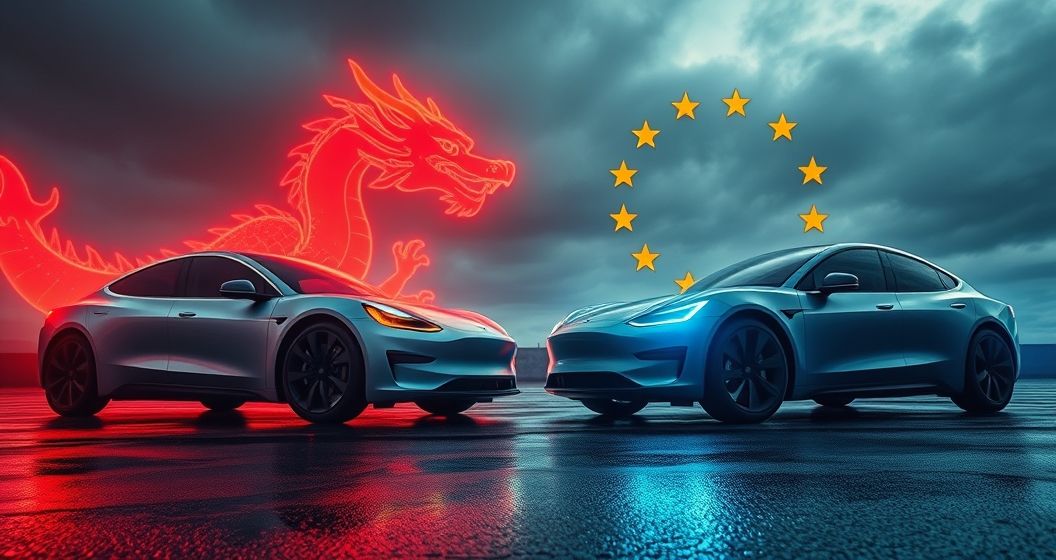
Tensions between Beijing and Brussels have escalated sharply following the European Union’s announcement of new provisional tariffs on Chinese electric vehicle imports. China has strongly condemned the move, labeling it as protectionism and warning of potential countermeasures. This development threatens to ignite a broader trade dispute between the two economic giants, placing significant pressure on the global automotive market and international supply chains. The decision has sparked immediate concern among industry leaders about the future of global trade.
The EU’s Anti-Subsidy Investigation
The European Commission’s decision follows a months-long investigation into China’s electric vehicle industry. Brussels alleges that Chinese EV manufacturers benefit from unfair state subsidies, allowing them to sell vehicles at artificially low prices in the European market. The tariffs, which could reach up to 38% for some companies, are intended to level the playing field and protect European carmakers from what the EU considers distorted competition. Officials stated the goal is not to close the market but to ensure fair conditions for all participants.
Beijing’s Firm Response
China’s Ministry of Commerce immediately voiced its “strong dissatisfaction” with the EU’s decision. Officials in Beijing argue that the tariffs lack a factual and legal basis, representing a clear violation of World Trade Organization rules. The government has accused the EU of using the investigation as a pretext to suppress Chinese industry and has urged the bloc to correct its course immediately to avoid further damaging economic and trade cooperation. Beijing maintains that its EV industry’s success is based on innovation and open competition, not subsidies.
Potential Retaliatory Measures
While Beijing has not specified its exact response, analysts believe retaliatory measures are highly probable. China has already launched its own anti-dumping investigation into certain European products. Potential targets for new Chinese tariffs could include European agricultural goods, such as pork and dairy, as well as luxury automobiles and aviation products. Such a move would directly impact key European export sectors, escalating the conflict from a targeted industry dispute to a wider trade standoff that could disrupt multiple industries.
Impact on Global Auto Industry
The dispute creates uncertainty for both Chinese and European automakers. Chinese brands like BYD, Geely, and SAIC, which have been expanding aggressively into Europe, now face significant barriers. Conversely, European manufacturers such as Volkswagen, BMW, and Mercedes-Benz, who have substantial operations and sales in China, are vulnerable to retaliatory actions. The tariffs could also lead to higher prices for European consumers, potentially slowing the continent’s transition to electric mobility and affecting climate goals.
The coming weeks will be critical in determining whether this dispute can be resolved through dialogue or if it will escalate into a full-blown trade war. Both sides have left the door open for negotiations, but their public stances remain firm. The global economic community is watching closely, as the outcome will have lasting implications for international trade norms, supply chains, and the future of the electric vehicle industry worldwide. The stability of the China-EU economic relationship hangs in the balance.


